
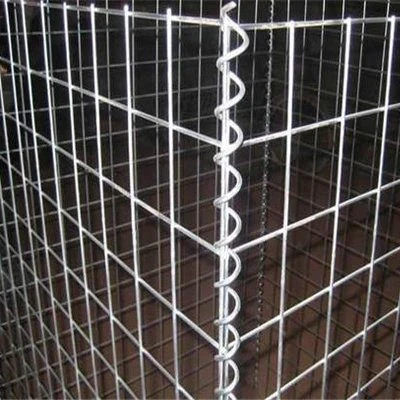

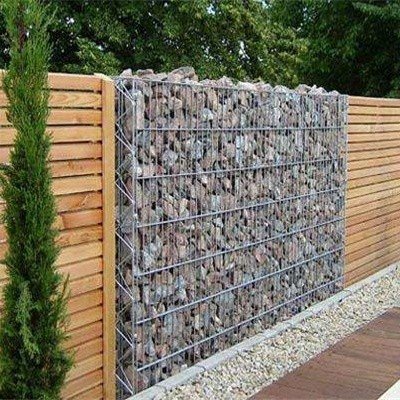
Our welded gabion baskets feature precision-welded wire intersections, forming a flat and highly rigid framework that prevents bulging under stone pressure. Treated with hot-dip galvanizing or PVC coating post-welding, these units deliver long-term anti-rust protection in harsh environments. Reinforced edge wires further bolster structural integrity, making them ideal for heavy-load retaining walls and modern landscape designs.
Product Parameters
|
Parameter |
Specification |
|
Wire Diameter ( mesh ) |
2.0 mm – 4.0 mm |
|
Edge Wire Diameter |
Larger than mesh wire (e.g., 3.0–4.5 mm) |
|
Mesh Opening |
50×50 mm, 100×100 mm, etc. |
|
Panel Size (L×W×H) |
Customizable (tolerance: length/width ±5%, height ±5%) |
|
Coating |
Hot-dip galvanized (up to 360 g/m²), or Galfan (5% Al-Zn), or PVC |
|
Tensile Strength |
350 – 520 MPa |
|
Internal Diaphragm |
Every 1 meter |
Product Advantages
Smoother wall surface, no bulging
Welded joints firmly fix the mesh, ensuring minimal deformation of the gabion sidewalls after stone filling. Compared to woven mesh, wall bulge rate is reduced by over 60%, resulting in a straight finish without secondary leveling.
Fast on-site assembly, saving labor time
The mesh panels are prefabricated in the factory and simply assembled on-site using connectors or spiral locks. Installation time is reduced by approximately 40% compared to woven gabion mesh, saving nearly half the installation time for the same wall.
Lower overall cost
On one hand, welded gabions are installed quickly, reducing labor costs by 25% to 35%; on the other hand, the structure itself is rigid, requiring almost no maintenance.
Installation Method
Foundation Preparation
Clear the site and level the foundation according to the design elevation. For soft soil foundations, a 100-150mm gravel layer needs to be laid and compacted.
Cage Assembly
The factory-prefabricated welded wire mesh is folded. After unfolding on site, the bottom plate is connected and fixed to the side and end plates using C-type fasteners or spiral locks, with one fastener every 100-150mm. Corners are reinforced with binding wire of the same material.
Cage Placement
The assembled empty cages are hoisted or manually moved to the designated location. Adjacent cages are tightly connected with binding wire or connectors to form a whole.
Layered Stone Filling
First, a layer of large-diameter stones (200-300mm) is manually placed at the bottom. Then, the remaining stones are filled in layer by layer, mechanically or manually, with each layer not exceeding 300mm in thickness. During filling, temporary supports (timber or steel pipes) are used to hold the side walls of the cage to prevent bulging.
Lid Closing
After filling to the top, the cover mesh is placed on top and fixed to the surrounding side plates with binding wire or fasteners. The binding spacing between the cover and the edge of the cage should be ≤150mm.
Subsequent Stacking
For multi-layer stacking, cover the bottom layer of boxes before stacking the second layer on top, staggering the joints between layers (similar to bricklaying), and securely connecting the layers with binding wire.
Applications
The welded gabion is widely used in civil and hydraulic engineering:
River training and flood control
Retaining walls and slope stabilization
Bridge protection
Coastal defense and port engineering
Erosion control for reservoirs and canals
Rockfall protection
Soil reinforcement and vegetation (green slope)
International Cooperation Cases
Dubai Artificial Island Project
Our company provided gabion and gabion mesh products for this landmark Middle Eastern construction project, used for coastal protection and foundation structure stabilization. The project had extremely high requirements for the corrosion resistance and stability of the materials, and we met the project's stringent technical standards by providing products with specific specifications.
Mekong River Flood Control Project
In this core water conservancy project in Southeast Asia, our products were used for riverbank reinforcement and flood control dike construction. This project placed high demands on the erosion resistance and settlement adaptability of the gabion mesh.
Red Sea Coastal Protection Project
Our products have been used in coastal protection and restoration projects in this region. The products must possess excellent resistance to seawater corrosion and permeability to adapt to the coastal ecological and hydrological environment.


FAQ
Q: Can the welded gabion be used in saltwater or high-corrosion environments?
A: Yes. When equipped with hot-dip galvanizing (≥360 g/m²) or Galfan coating, it can be applied to marine and coastal high-corrosion scenarios.
Q: How are welded gabions shipped?
A: They are folded into flat bundles to save shipping space and cut freight costs. On-site assembly is completed with spiral binders.
Q: What is the service life of a welded gabion?
A: With standard hot-dip galvanizing (260 g/m²), the service life reaches 20–30 years. Galfan or PVC coating can extend the service life to more than 50 years in severe environments.
Hot Tags: welded gabion, China welded gabion manufacturers, suppliers, factory, harbor protection gabion mesh, Welded Gabion Baskets, woven gabion mesh, galvanised gabion, Gabion Spiral Wire, wire rock baskets


