


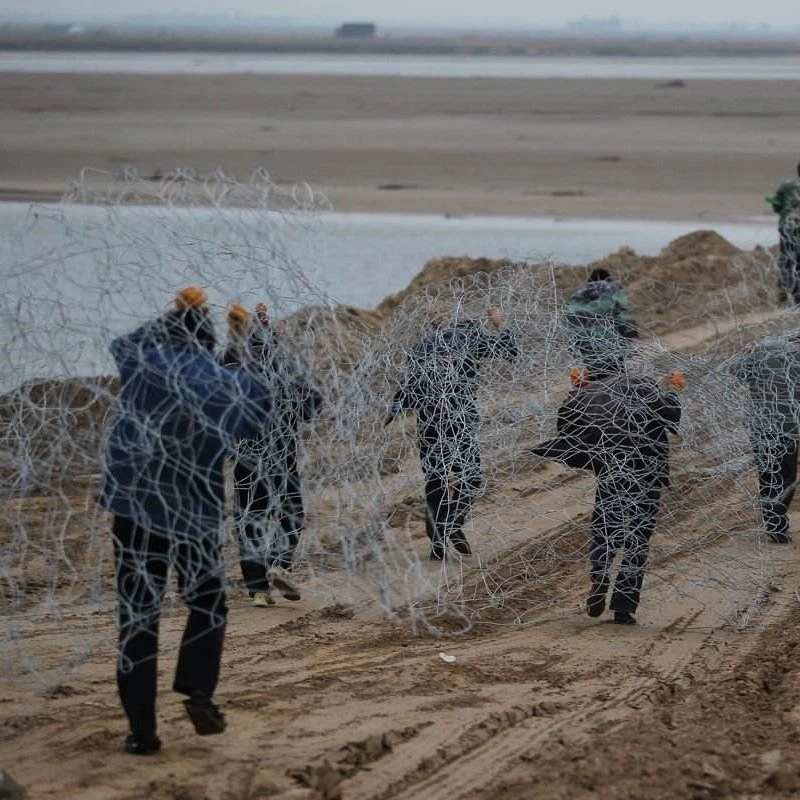

Gabion retaining wall is a flexible retaining structure composed of high-strength metal wire woven mesh boxes filled with stones. It has the characteristics of structural stability, strong erosion resistance, environmental protection, simple construction and economical and practical application. It is widely used in river management, slope protection, dam construction and landscape engineering.
Core Advantages
Stable Structure
The double-twisted hexagonal mesh structure gives the entire mesh a tensile strength ≥35kN/m. After filling with stones, it forms a gravity-type integral load-bearing system, capable of withstanding soil and water pressure, suitable for retaining walls up to 3 meters in height.
01
Erosion Resistance
The densely packed stone filling layer can resist erosion from water flows ≤5m/s; the gaps between the boxes allow water exchange, reducing direct impact on the wall, suitable for high-velocity areas such as rivers and spillways.
02
Rapid construction
The mesh is prefabricated in the factory, folded and assembled on-site, and filled with stones; no concrete curing is required. For retaining walls of the same volume, the construction period is reduced by more than half compared to concrete structures, and labor costs are reduced by approximately 30%.
03
High Cost-Effectiveness
The main materials are steel wire and stone, with an overall cost only 70%-80% of that of a concrete retaining wall of the same height; effective anti-corrosion treatment results in extremely low maintenance costs.
04
Comparison
| Comparison Items | Gabion Mesh Retaining Wall | Masonry retaining wall | Concrete retaining wall |
|
Foundation adaptability
|
Excellent (±5% settlement)
|
Poor quality (prone to cracking)
|
Generally (seam required)
|
|
Drainage system
|
No settings required
|
Drainage holes need to be installed
|
Drainage holes need to be installed
|
|
Construction machinery
|
Manual labor + small forklift
|
Mortar mixer required
|
Concrete pump truck required
|
|
Winter construction
|
Can be performed
|
Needs protection from freezing
|
Generally not advisable
|
|
Dismantling and Recycling
|
Steel wire is recyclable
|
Waste residue is difficult to handle
|
High crushing costs
|
|
Plant growth
|
Naturally growing grass
|
None
|
None
|
|
Comprehensive cost
|
Benchmark
|
10-20% higher
|
20-30% higher
|
Installation Notes
Place the baskets on a level, compacted foundation with the required filter layer or geotextile behind the structure. Connect adjacent panels before filling, install diaphragms and internal ties at the specified positions, and place stone in controlled lifts to avoid excessive face deformation. The exposed face should be hand-packed with selected stone, while the interior can be filled with properly graded rock that meets the project specification.
*The final basket dimensions, mesh opening, wire diameter, coating mass, connector type, and stone grading should be confirmed against the engineer's drawings and the applicable ASTM or EN requirements.
Maintenance and Inspection
Daily Inspection: Before and after the annual flood season, check the wall surface for stone loss, mesh corrosion, and localized bulging.
Simple Repair: For small areas of stone loss, directly fill with stones of the same size; for damaged mesh, patch and cover with mesh of the same material.
Rust Treatment: For localized galvanized layer peeling, spray with zinc-rich primer; for large-area rust, the mesh needs to be replaced, free of charge within the warranty period.
Company Advantages
Production Capacity
Daily capacity of 100,000 square meters, annual capacity exceeding 5 million square meters, equipped with fully automated weaving lines and anti-corrosion production lines, capable of stably undertaking large international orders.
Quality Control
Eight quality inspection processes covering raw materials to finished products, each batch accompanied by spectral analysis, zinc layer thickness measurement, whole mesh tensile testing, and salt spray reports, supporting SGS/BV on-site inspection.
Certifications
Certified by ISO 9001, ISO 14001, and CE; products comply with international standards such as ASTM A975 and EN 10223-3.We can also provide material, coating, and dimensional inspection records upon request.
Global Achievements
Products exported to over 30 countries, used in landmark projects such as the Dubai artificial islands, Mekong River flood control, and Red Sea coastline protection. After-sales guarantee: Ten-year warranty, on-site technical guidance, multilingual installation materials, and old mesh recycling service.


FAQ
Q: Can Gabion Mesh Retaining Walls be built in riverbeds? Are special foundations required?
A: Yes. During underwater construction, first fill with crushed stone to level the surface, then place empty mesh cages directly, sinking them as stones are added. The foundation only requires clearing silt and backfilling with crushed stone; no cofferdam or dewatering is needed.
Q: How long do Gabion Mesh Retaining Walls last, and how do I choose between Hot-Dip Galvanized, Galfan, and PVC coatings?
A: Hot-Dip Galvanized: Suitable for ordinary freshwater environments in inland areas, with a service life of approximately 20–25 years.
Galfan (Zn-5%Al / Zn-10%Al Alloy): Offers excellent corrosion resistance, suitable for high humidity, acid rain, and highly corrosive environments, with a service life of up to 40–50 years.
PVC/PE Coating: Specifically designed for marine seawater, high-salinity and alkaline soils, and highly acidic or alkaline soils. An additional polymer protective film is added to the galvanized/galfan coating, extending the service life to over 50 years.
Q: Does the packaging meet the requirements for rust prevention during sea transport when exporting the product?
A: Yes. After compression and bundling, an anti-rust film is wrapped around the outer layer, corner protectors are added to the four corners, and steel straps are used for reinforcement. For transport in salt spray environments, desiccants can be added or vacuum packaging can be used.
Hot Tags: gabion mesh retaining wall, China gabion mesh retaining wall manufacturers, suppliers, factory, gabion rock cage retaining wall, welded gabion cages, retaining wall metal cage, harbor protection gabion mesh, wire rock baskets, Reinforced Gabion Mesh


